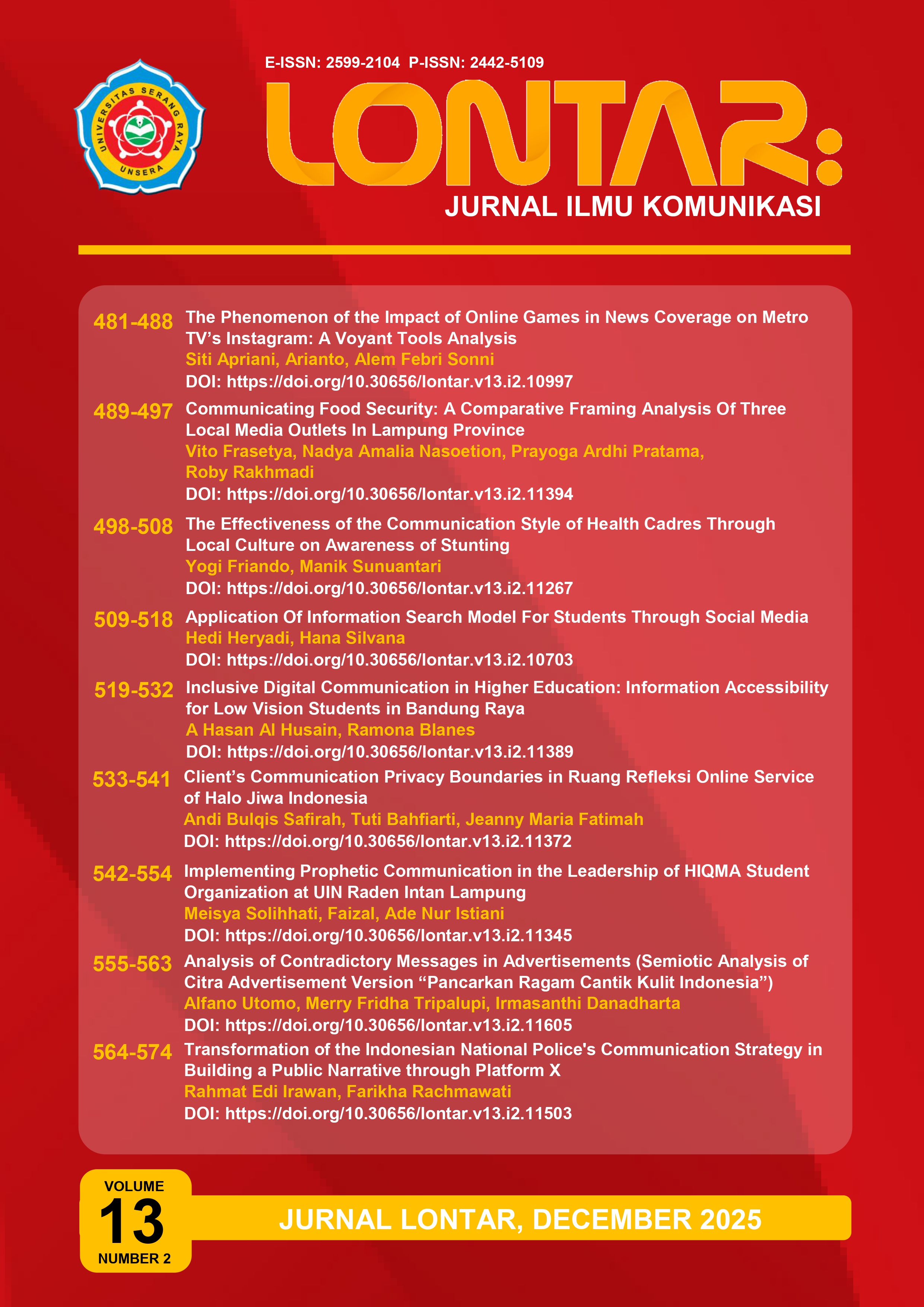
Communicating Food Security: A Comparative Framing Analysis Of Three Local Media Outlets In Lampung Province
DOI:
https://doi.org/10.30656/lontar.v13.i2.11394Keywords:
Food security, Local media, Framing analysis, Lampung, Development CommunicationAbstract
This research examines the role of local media in Bandarlampung in analyzing food security information through framing analysis. As one of Indonesia's food granaries, Lampung Province faces complex food security challenges requiring effective communication strategies. Using Robert N. Entman's framing model, this qualitative study analyzed 487 articles from three local media outlets (Lampung Post, Radar Lampung, and Tribun Lampung) published during January-December 2024. The research employed document analysis, in-depth interviews with nine journalists and editors, and focus group discussions with twelve participants. Findings reveal two dominant themes: agricultural production and commodity price fluctuations. Each media outlet demonstrates distinct editorial approaches, with Lampung Post emphasizing local food sovereignty, Radar Lampung focusing on innovation and modernization, and Tribun Lampung prioritizing farmer welfare impacts. The study identifies structural, professional, and contextual factors influencing framing patterns. Analysis of the controversial regional regulation on grain trade restrictions illustrates how divergent media framing creates fragmented public discourse and influences policy processes. Media framing significantly impacts public understanding and policy formulation regarding food security. This research contributes to framing theory application in local media contexts and provides practical implications for improving food security communication strategies in Indonesia.
References
Anggraini, R. D. (2019). Framing analysis of agricultural news in Lampung local media. Jurnal Komunikasi Pembangunan, 17(2), 156-172.
Ashari, M., & Sanusi, A. (2021). Framing of food crisis issues in Indonesian online media during the COVID-19 pandemic. Jurnal Komunikasi Indonesia, 10(2), 145-162.
Barrett, C. B. (2010). Measuring food insecurity. Science, 327(5967), 825-828.
Birkland, T. A. (2007). Lessons of disaster: Policy change after catastrophic events. Washington, DC: Georgetown University Press.
Clapp, J. (2014). Financialization, distance and global food politics. Journal of Peasant Studies, 41(5), 797-814.
Creswell, J. W. (2013). Qualitative inquiry and research design: Choosing among five approaches (3rd ed.). Thousand Oaks, CA: SAGE Publications.
Devereux, S. (2007). The impact of droughts and floods on food security and policy options to alleviate negative effects. Agricultural Economics, 37(s1), 47-58.
Entman, R. M. (1993). Framing: Toward clarification of a fractured paradigm. Journal of Communication, 43(4), 51-58.
FAO. (2009). Declaration of the World Summit on Food Security. Rome: Food and Agriculture Organization.
FAO. (2011). The state of food and agriculture 2010-2011: Women in agriculture. Rome: Food and Agriculture Organization.
Gamson, W. A., & Modigliani, A. (1989). Media discourse and public opinion on nuclear power: A constructionist approach. American Journal of Sociology, 95(1), 1-37.
Herman, E. S., & Chomsky, N. (2002). Manufacturing consent: The political economy of the mass media. New York: Pantheon Books.
Lang, T., Barling, D., & Caraher, M. (2009). Food policy: Integrating health, environment and society. Oxford: Oxford University Press.
Lincoln, Y. S., & Guba, E. G. (1985). Naturalistic inquiry. Beverly Hills, CA: SAGE Publications.
McCombs, M. E., & Shaw, D. L. (1972). The agenda-setting function of mass media. Public Opinion Quarterly, 36(2), 176-187.
McMichael, P. (2009). A food regime genealogy. Journal of Peasant Studies, 36(1), 139-169.
Mefalopulos, P. (2008). Development communication sourcebook: Broadening the boundaries of communication. Washington, DC: World Bank.
Naylor, R. L., & Falcon, W. P. (2010). Food security in an era of economic volatility. Population and Development Review, 36(4), 693-723.
Nielsen, R. K. (2015). Local journalism: The decline of newspapers and the rise of digital media. London: I.B. Tauris.
Pretty, J., Sutherland, W. J., Ashby, J., Auburn, J., Baulcombe, D., Bell, M., ... & Pilgrim, S. (2010). The top 100 questions of importance to the future of global agriculture. International Journal of Agricultural Sustainability, 8(4), 219-236.
Reese, S. D. (2001). Prologue—Framing public life: A bridging model for media research. In S. D. Reese, O. H. Gandy, & A. E. Grant (Eds.), Framing public life: Perspectives on media and our understanding of the social world (pp. 7-31). Mahwah, NJ: Lawrence Erlbaum.
Saparita, R., Widodo, S., & Kurnia, N. (2020). Framing of food security in Indonesian national media. Jurnal Ilmu Komunikasi, 18(1), 23-40.
Scheufele, D. A., & Tewksbury, D. (2007). Framing, agenda setting, and priming: The evolution of three media effects models. Journal of Communication, 57(1), 9-20.
Schmidhuber, J., & Tubiello, F. N. (2007). Global food security under climate change. Proceedings of the National Academy of Sciences, 104(50), 19703-19708.
Schudson, M. (2001). The objectivity norm in American journalism. Journalism, 2(2), 149-170.
Shaw, D. J. (2012). World food security: A history since 1945. London: Palgrave Macmillan.
Shoemaker, P. J., & Reese, S. D. (2014). Mediating the message in the 21st century: A media sociology perspective (3rd ed.). New York: Routledge.
Simon, F. L. (2008). Framing the global food crisis: Media coverage of price spikes in 2008. Journal of Communication, 1(1), 1-12.
Stone, D. (2012). Policy paradox: The art of political decision making (3rd ed.). New York: W.W. Norton & Company.
Sumadiria, H., & Fadilah, D. (2022). Framing analysis of food estate program coverage in Indonesian national media. Komunikasi Indonesia, 11(3), 234-251.
Law of the Republic of Indonesia Number 18 of 2012 on Food.
Law of the Republic of Indonesia Number 7 of 2014 on Trade.
Yin, R. K. (2018). Case study research and applications: Design and methods (6th ed.). Thousand Oaks, CA: SAGE Publications.
Downloads
Published
Issue
Section
License
Copyright (c) 2025 LONTAR: Jurnal Ilmu Komunikasi

This work is licensed under a Creative Commons Attribution 4.0 International License.
By submitting an article to the journal, the author(s) agree to transfer the published article's copyright to the journal, which will act as the publisher. This means the journal will have the right to publish the article in various forms, including reprints. The journal will maintain the publishing rights to the published articles.
In line with the license, authors and third parties (readers, researchers, and others) are allowed to share and adapt the material. In addition, the material must be given appropriate credit, provided with a link to the license, and indicated if changes were made. If authors remix, transform, or build upon the material, authors must distribute their contributions under the same license as the original.