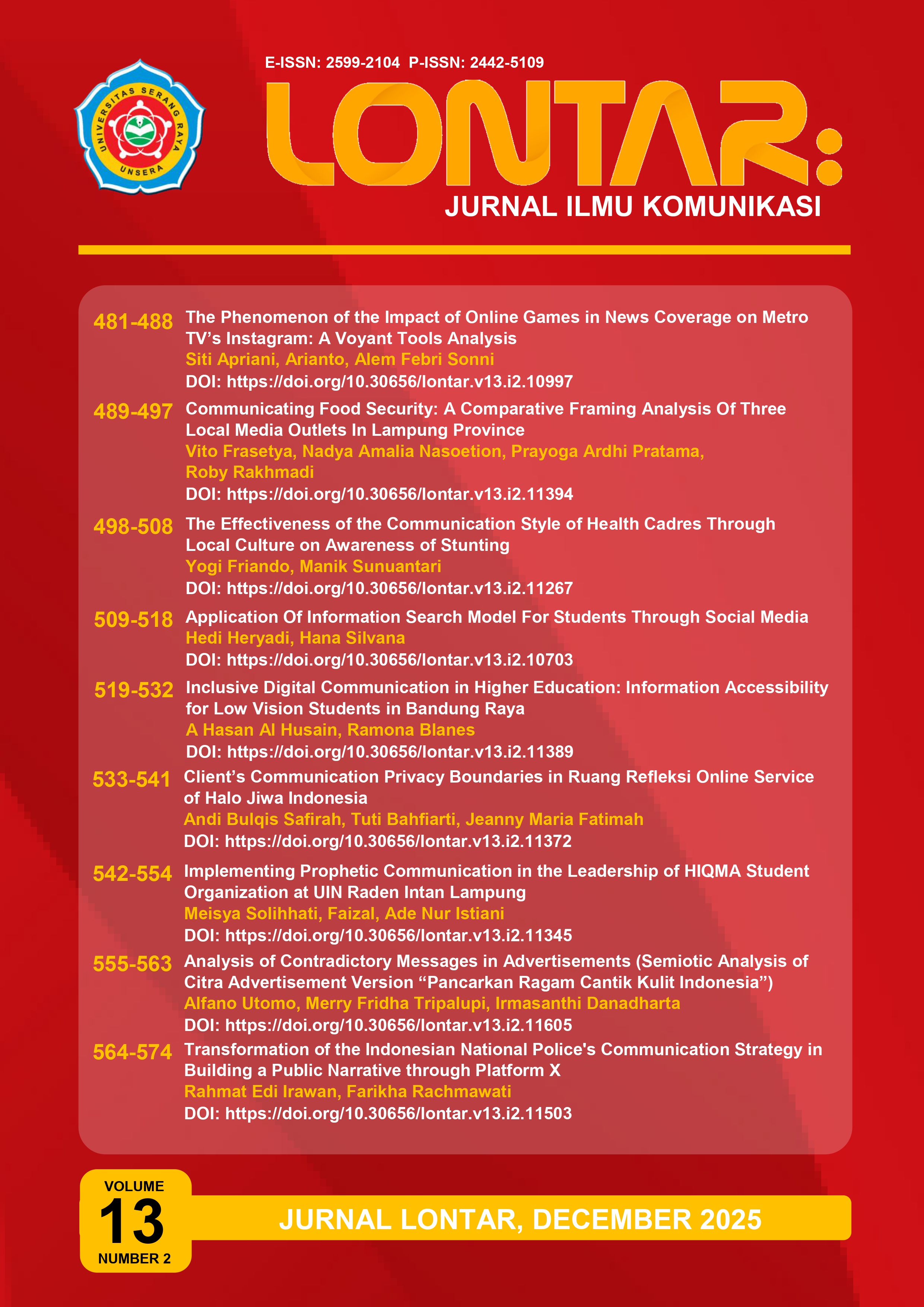
Client’s Communication Privacy Boundaries in Ruang Refleksi Online Service of Halo Jiwa Indonesia
DOI:
https://doi.org/10.30656/lontar.v13.i2.11372Keywords:
Communication Privacy Management, e-counseling, peer counseling, Halo Jiwa Indonesia, Ruang Refleksi OnlineAbstract
Ruang Refleksi Online (RRO), or Online Reflection Room, is one of Halo Jiwa Indonesia’s online-based counseling services, providing emotional support to people since the COVID-19 pandemic. This online-based counseling is a free and non-professional service provided by peer counselors from Halo Jiwa Indonesia members, which was held in 2020. This study aims to know how the client manages their privacy rules in peer counseling, according to five criteria of Communication Privacy Management in boundary rules, which are culture, motivation, context, gender, and risk-benefit ratio. This research type is a qualitative method with a case study approach. Four clients were chosen from purposive sampling with a specific category. From this study, it can be concluded that clients of Ruang Refleksi Online created their privacy rule according to their motivation, contextual, and risk-benefit ratio factors. This determines how much self-disclosure they can share with the peer counselor during interpersonal communication in the counseling session. The clients could also feel the positive impact, such as feeling calmer and relieved from Ruang Refleksi Online
References
Awi, M. V., Mewengkang, N., & Golung, A. (2016). Peranan Komunikasi Antar Pribadi dalam Menciptakan Harmonisasi Keluarga di Desa Kimaam Kabupaten Merauke. E-Journal “Acta Diurna,” 5(2), 1–12.
Bahfiarti, T. (2020). Batasan Privasi Komunikasi Interpersonal Perempuan Muslim Bercadar di Kota Makassar. Jurnal Jurnalisa, 6(1).
Bungin, B. (2007). Metodologi penelitian kualitatif: Aktualisasi metodologis ke arah ragam varian kontemporer.
Cangara, H. (2014). Pengantar Ilmu Komunikasi (Edisi Kedua). In Jakarta: PT Rajagrafindo Persada.
Dr. Umar Sidiq, M.Ag Dr. Moh. Miftachul Choiri, M. (2019). Metode Penelitian Kualitatif di Bidang Pendidikan. In Journal of Chemical Information and Modeling (Vol. 53, Issue 9).
Fitriyah, N., & Gunadarma, U. (2025). Pengaruh Self-Esteem dan Trust terhadap Self-Disclosure pada Individu yang Menjalani Cyber Love Relationship. 9(2018), 12443–12449.
Haryati, A. (2020). Online Counseling Sebagai Alternatif Strategi Konselor dalam Melaksanakan Pelayanan E-Counseling di Era Industri 4.0. Bulletin of Counseling and Psychotherapy, 2(2), 27–38.
Iqbal, M., & Rizqulloh, L. (2020). Deteksi Dini Kesehatan Mental Akibat Pandemi Covid-19 Pada Unnes Sex Care Community Melalui Metode Self Reporting Questionnaire. PRAXIS, 3(1). https://doi.org/10.24167/praxis.v3i1.2730
Kusmarni, Y. (2012). Studi kasus. UGM Jurnal Edu UGM Press.
Marlischa, D. D., & Rahmanto, A. N. (n.d.). PENGUNGKAPAN DIRI MENGENAI KESEHATAN MENTAL PADA KEGIATAN “RUANG REFLEKSI” KOMUNITAS HALO JIWA INDONESIA.
Muhiddin, S., Yudistikhar, A., Idham, A. F., Massinai, S. M. M., Mustamin, S. N., & Wodong, G. M. A. (2021). “Ruang Refleksi”: Insight dari Program Pendampingan Sebaya Daring di Masa Pandemi COVID-19. INSAN Jurnal Psikologi Dan Kesehatan Mental, 6(2). https://doi.org/10.20473/jpkm.v6i22021.90-105
Nasrullah, N., & Sulaiman, L. (2021). Analisis pengaruh COVID-19 terhadap kesehatan mental masyarakat di Indonesia. Media Kesehatan Masyarakat Indonesia, 20(3), 206–211.
Nugrahani, F., & Hum, M. (2014). Metode penelitian kualitatif. Solo: Cakra Books, 1(1).
Rahmi, S. (2021). Komunikasi interpersonal dan hubungannya dalam konseling. Syiah Kuala University Press.
Rusnali, A. (2017). Komunikasi Antar Manusia. Giallorossi Publisher.
Saptandari, E. W., Praptomojati, A., Handoyo, R. T., Anjarsari, N. D., & Mahambara, Y. G. R. (2022). Layanan Telekonseling: Psychological First Aid dalam Situasi Pandemi COVID-19. Jurnal Psikologi Teori Dan Terapan, 13(1), 51–71.
Sholihah, M., Kusuma, R. S., & Kom, S. I. K. M. I. (2020). Manajemen Privasi Komunikasi Pengguna Instagram Dewasa Dalam Menggunakan Fitur Instastory. Universitas Muhammadiyah Surakarta.
Downloads
Published
Issue
Section
License
Copyright (c) 2025 LONTAR: Jurnal Ilmu Komunikasi

This work is licensed under a Creative Commons Attribution 4.0 International License.
By submitting an article to the journal, the author(s) agree to transfer the published article's copyright to the journal, which will act as the publisher. This means the journal will have the right to publish the article in various forms, including reprints. The journal will maintain the publishing rights to the published articles.
In line with the license, authors and third parties (readers, researchers, and others) are allowed to share and adapt the material. In addition, the material must be given appropriate credit, provided with a link to the license, and indicated if changes were made. If authors remix, transform, or build upon the material, authors must distribute their contributions under the same license as the original.