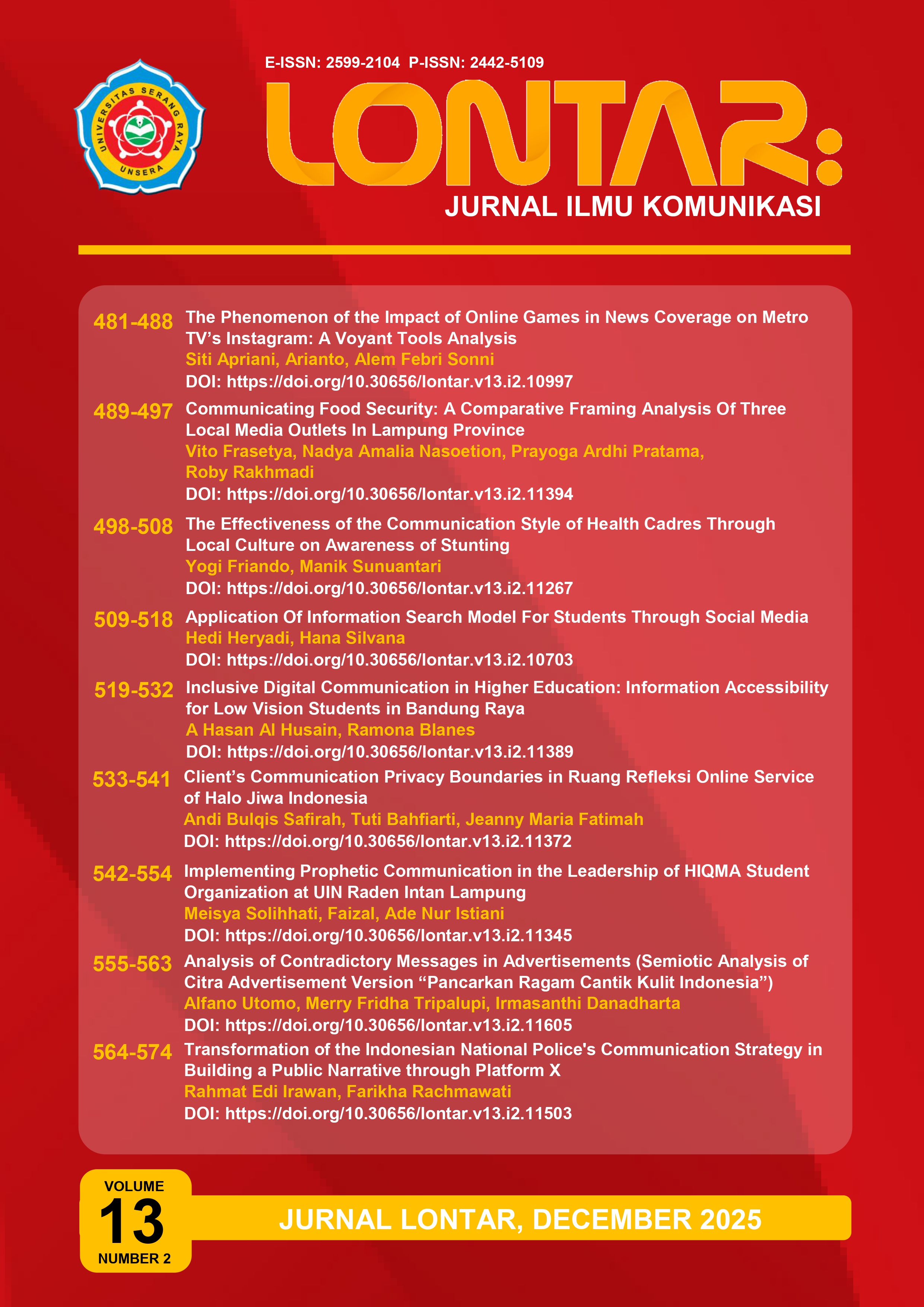
Implementing Prophetic Communication in the Leadership of HIQMA Student Organization at UIN Raden Intan Lampung
DOI:
https://doi.org/10.30656/lontar.v13.i2.11345Keywords:
Prophetic Communication, Leadership, Humanization, Liberation, TranscendenceAbstract
This study aims to analyze the implementation of prophetic communication in the leadership of the Student Activity Unit (UKM) HIQMA at UIN Raden Intan Lampung. Prophetic communication is based on three main pillars: humanization (amar ma’ruf), liberation (nahi munkar), and transcendence (tu’minuna billah). The research employed a descriptive qualitative method, using interviews, observations, and documentation as data collection techniques. The informants consisted of active administrators, alumni leaders, and members of UKM HIQMA selected through purposive sampling. The findings indicate that humanization is reflected in empathetic leadership, attention to members’ needs, and mentoring, which foster emotional closeness and organizational loyalty. Liberation is evident in the way leaders provide constructive criticism in a gentle and respectful manner, enabling members to grow with confidence. Transcendence appears through the integration of worship values such as prayer, dhikr, and Qur’anic recitation into organizational activities, which strengthens members’ spiritual motivation. Overall, prophetic leadership in UKM HIQMA successfully creates a humane, ethical, and spiritual organizational culture, proving the relevance of prophetic communication within student organizations.
References
Amin, H. U. (2024). Pengembangan Organisasi Melalui Nilai-Nilai Kepemimpinan Profetik. Jurnal Ilmu Administrasi Dan Studi Kebijakan (JIASK), 6(2), 175–186. https://doi.org/10.48093/jiask.v6i2.205
Aries, A. (2024). Strategic Communication of Local Government. LONTAR: Jurnal Ilmu Komunikasi, 12(1), 216–227. https://doi.org/10.30656/lontar.v12i1.8216
Aulia, F., Dwianggraeni, P. R., & Ishak, A. R. (2023). Peran Organisasi Mahasiswa dalam Meningkatkan Kemampuan Komunikasi Interpersonal yang Efektif. Jurnal Mahasiswa Komunikasi Cantrik, 3(2), 141–150. https://doi.org/10.20885/cantrik.vol3.iss2.art5
Budiharto, S., & Himam, F. (2022). Konstruk Teoritis dan Pengukuran Kepemimpinan Profetik. Jurnal Psikologi Fakultas Psikologi Universitas Gadjah Mada, 33(2), 133–146.
Dharmawan, D. (2022). IMPLEMENTASI NILAI-NILAI KOMUNIKASI PROFETIK PADA REMAJA MAJELIS RASULULLAH Miftahussa’adah Wardi 2) 2 Sekolah Tinggi Agama Islam At-Taqwa Bekasi. 27–37.
Fannani, Z. (2014). Tafsir surat an-nahl ayat 125 (kajian tentang metode pembelajaran). Skripsi, 125, 42.
Ibnu Sholeh, M., Tanzeh, A., Fuadi, I., & Kojin. (2023). Kepemimpinan Profetik (Study Proses Peningkatan Lembaga Pendidikan Islam di Indonesia). JMPI: Jurnal Manajemen, Pendidikan Dan Pemikiran Islam, 1(1), 27–44. https://doi.org/10.71305/jmpi.v1i1.9
Lubis, M. A. (2018). KOMUNIKASI NONVERBAL DALAM PERSPEKTIF ISLAM (Studi Tafsir Terhadap Surah ’Abasa). 1(1), h 29-39.
Malik, M. S., Nikmah, L., Wati, I. F., Ardhyantama, V., Imaduddin, M., Andriningrum, H., & Maslahah. (2024). Etika Komunikasi dalam Al-Qur’an dan Hadis. ASNA: Jurnal Kependidikan Islam Dan Keagamaan, 6(2), 24–40.
Muhlis, M., & Musliadi, M. (2022). Komunikasi Profetik Di Media Sosial. RETORIKA : Jurnal Kajian Komunikasi Dan Penyiaran Islam, 4(2), 82–92. https://doi.org/10.47435/ retorika.v4i2.1177
Nurjanah, T. (2024). Etika Komunikasi Perspektif Agama Islam. https://doi.org/10.47902/al-akmal.v3i6
Paramita, T. sugiri syah putri, & Rahayu, U. (2024). KOMUNIKASI PROFETIK DI MEDIA SOSIAL DALAM KONFLIK PALESTINA ISRAEL. 3(1), 111–121.
Rahman, Muh. Aswad, Aldiawan, & Badar. (2023). Konsep Komunikasi Profetik (Kenabian) Sebagai Strategi Dakwah. Shoutika, 2(1), 1–6. https://doi.org/10.46870/jkpi.v2i1.215
Ridho, A. R. (2021a). KOMUNIKASI PROFETIK DALAM MEWUJUDKAN MASYARAKAT MADANI PERSPEKTIF AL-QUR’AN (Vol. 2, Issue 4).
Ridho, A. R. (2021b). Peran Komunikasi Profetik Dalam Pembentukan Etika Publik Masyarakat Madani Perspektif Al-Qura’an. Jurnal Ilmu Al Quran Dan Tafsir, 139–158.
Saleh, M., Heryadi, A. I., Kambali, L., Aspirani, A., & Abdullah, A. (2024). Peran Komunikasi Dalam Kepemimpinan Efektif Pada Organisasi Mahasiswa. Jurnal Inspirasi Ilmu Manajemen, 3(1), 64–69. https://doi.org/10.32897/jiim.2024.3.1.3762
Salsabilla, I., Murdiati, E., & Hamandia, M. (2025). Analisis Komunikasi Profetik Pada Program Mukim Yayasan Pendidikan Rumah Quran El-Fajr. Jurnal Studi Ilmu Alquran Dan Tafsir, 1(3), 9. https://doi.org/10.47134/jsiat.v1i3.179
Tania Putri, E. (2024). Implementasi Nilai-Nilai Komunikasi Profetik Dalam Film Buya Hamka. Glosains: Jurnal Sains Global Indonesia, 5(1), 1–10. https://doi.org/10.59784/ glosains.v5i1.501
Yanti, F. (2014). Meneropong Paradigma Komunikasi Profetik. Jurnal Ilmu Komunitas Dan Pengembangan, 9(1), 45–56. http://ejournal.radenintan.ac.id/index.php/alummah/ article/view/578
Yeza Pradhipta, A., & Fiani, I. D. (2025). Group Communication Patterns of Universitas Terbuka Students’ Online Community on WhatsApp. LONTAR: Jurnal Ilmu Komunikasi, 13(1), 408–418. https://doi.org/10.30656/lontar.v13.i1.10294
Downloads
Published
Issue
Section
License
Copyright (c) 2025 LONTAR: Jurnal Ilmu Komunikasi

This work is licensed under a Creative Commons Attribution 4.0 International License.
By submitting an article to the journal, the author(s) agree to transfer the published article's copyright to the journal, which will act as the publisher. This means the journal will have the right to publish the article in various forms, including reprints. The journal will maintain the publishing rights to the published articles.
In line with the license, authors and third parties (readers, researchers, and others) are allowed to share and adapt the material. In addition, the material must be given appropriate credit, provided with a link to the license, and indicated if changes were made. If authors remix, transform, or build upon the material, authors must distribute their contributions under the same license as the original.